State of the Minnesota Cannabis Market: May 2026
Update (Oct. 2026): Congress has delayed most of the federal hemp change. H.R. 6500 (the Continuing Appropriations and Extensions Act, 2027) passed the Senate on Aug. 8, 2026, and the House on Sept. 1, 2026 (370-48), and was signed on Sept. 2, 2026. Most of the new federal hemp definition, including the 0.4 mg total THC per-container limit, now takes effect Dec. 11, 2026, not Nov. 12. One narrow part still starts Nov. 12, 2026: products containing cannabinoids that the cannabis plant cannot naturally produce. Minnesota's own lower-potency hemp law does not change on either date. For the current picture, see our December 11 explainer and THC drinks in Minnesota. Educational information, not legal advice.
By Jaycub | MN Cannabis Hub | Published May 30, 2026
May was the month the legislature stopped tinkering and started rewiring. In the final hours of the 2026 session, lawmakers passed a sweeping cannabis omnibus bill (signed by Gov. Walz on May 26, 2026) that merges the medical and adult-use supply chains into one system, builds an on-ramp for hemp operators to cross into the regulated market, and hands every licensee a built-in extension to actually open their doors. Gov. Walz signed it on May 26. That's the headline, and it reshapes nearly everything we've been writing about for the last four months.
But it wasn't the only thing that moved. One of the state's handful of fully licensed testing labs got frozen by regulators and started shipping samples back to clients. Kwik Trip and Target quietly became the two biggest hemp THC retailers in Minnesota, which has every small dispensary owner in the state grinding their teeth. The first capped-license lotteries finally got a date. And the November federal hemp ban is still sitting out on the horizon like weather nobody wants to talk about.
If you read April's report, you've got the runway. This is the takeoff. Let's get into it the way you'd actually want to read it, coffee in hand, not buried in a committee transcript.

Quick Take: What Actually Matters in May
For the two-minute crowd, here's the short version before we go deep:
- The omnibus bill passed. Minnesota merged its medical and adult-use supply chains, created a path for hemp businesses to enter the regulated market, and gave every licensee an automatic six-month extension to open. This is the most consequential cannabis law since legalization itself.
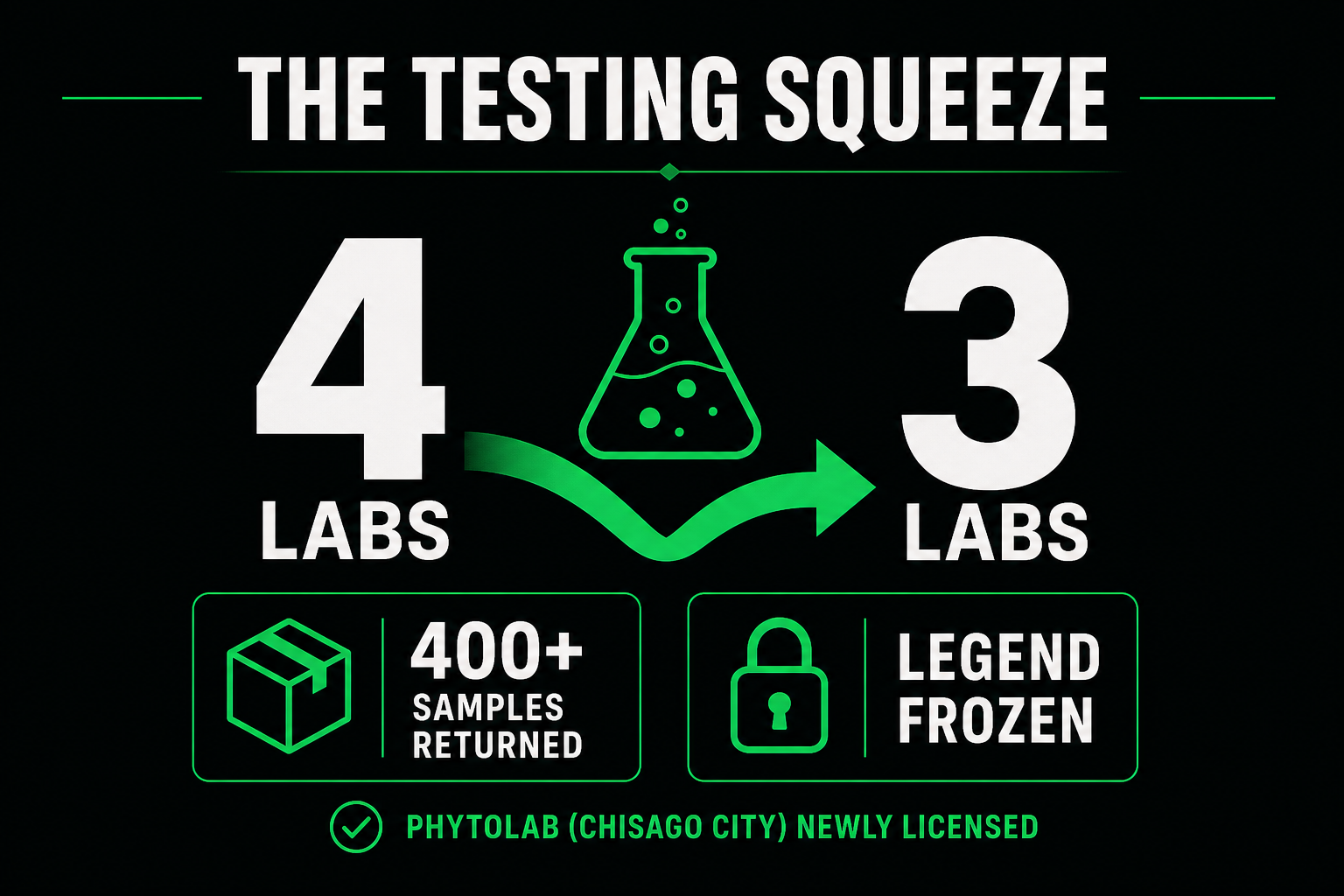
- A major testing lab got frozen. OCM ordered Legend Technical Services in St. Paul to stop testing after its launch-era variances expired, and the lab is returning more than 400 samples to clients. That leaves three fully licensed labs for the entire state.
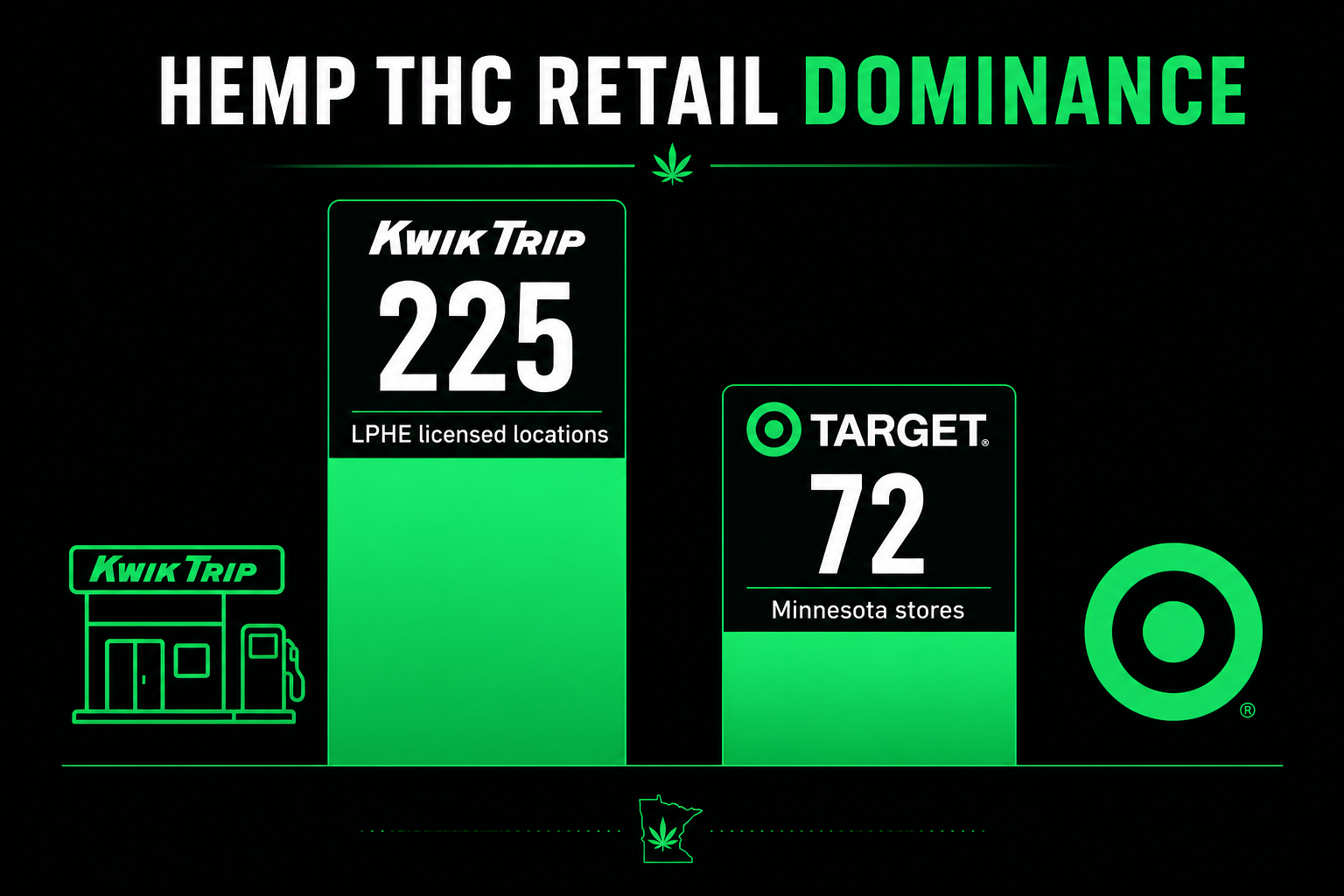
- Big-box retail is winning hemp THC. Kwik Trip now holds the most lower-potency hemp edible licenses in Minnesota at 225 locations, and Target locked in all 72 of its Minnesota stores. Small dispensaries are not thrilled.
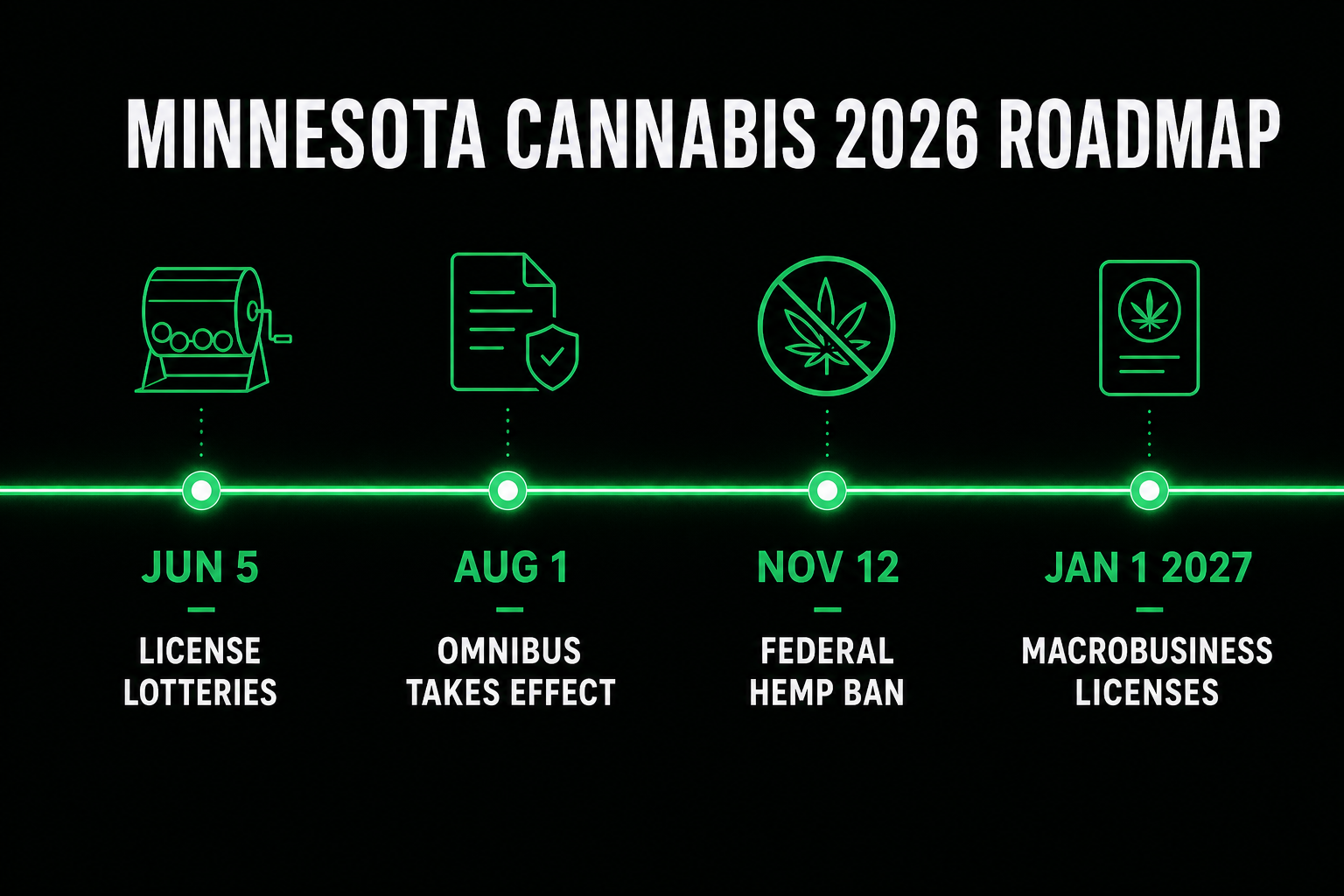
- License lotteries land June 5. OCM set the date for the first capped-license lotteries covering cultivator, manufacturer, and mezzobusiness types, with social equity applicants drawn first.
- The hemp line is blurring fast. The omnibus bill allows shared ownership, shared premises and equipment, and "ratio" hemp CBN products inside dispensaries. The wall between hemp and adult-use is coming down.
- CBG is the next consumer story. Industry newsletters are already calling cannabigerol "the next CBD" as the wellness conversation moves past the usual cannabinoids.
- Federal hemp ban watch: November 12, 2026 is still the date circled in red. No federal fix has passed. (Update, Oct. 7, 2026: most of this federal change now takes effect Dec. 11, 2026, delayed from Nov. 12 by H.R. 6500.)
Now let's get into it.
Find an Open Dispensary Near You
Trying to figure out which dispensaries are actually open and selling product? We track every operational dispensary in Minnesota with live menus and reviews.
View Directory Check DealsThe Sales Picture: Steady Climb, Supply Still the Ceiling
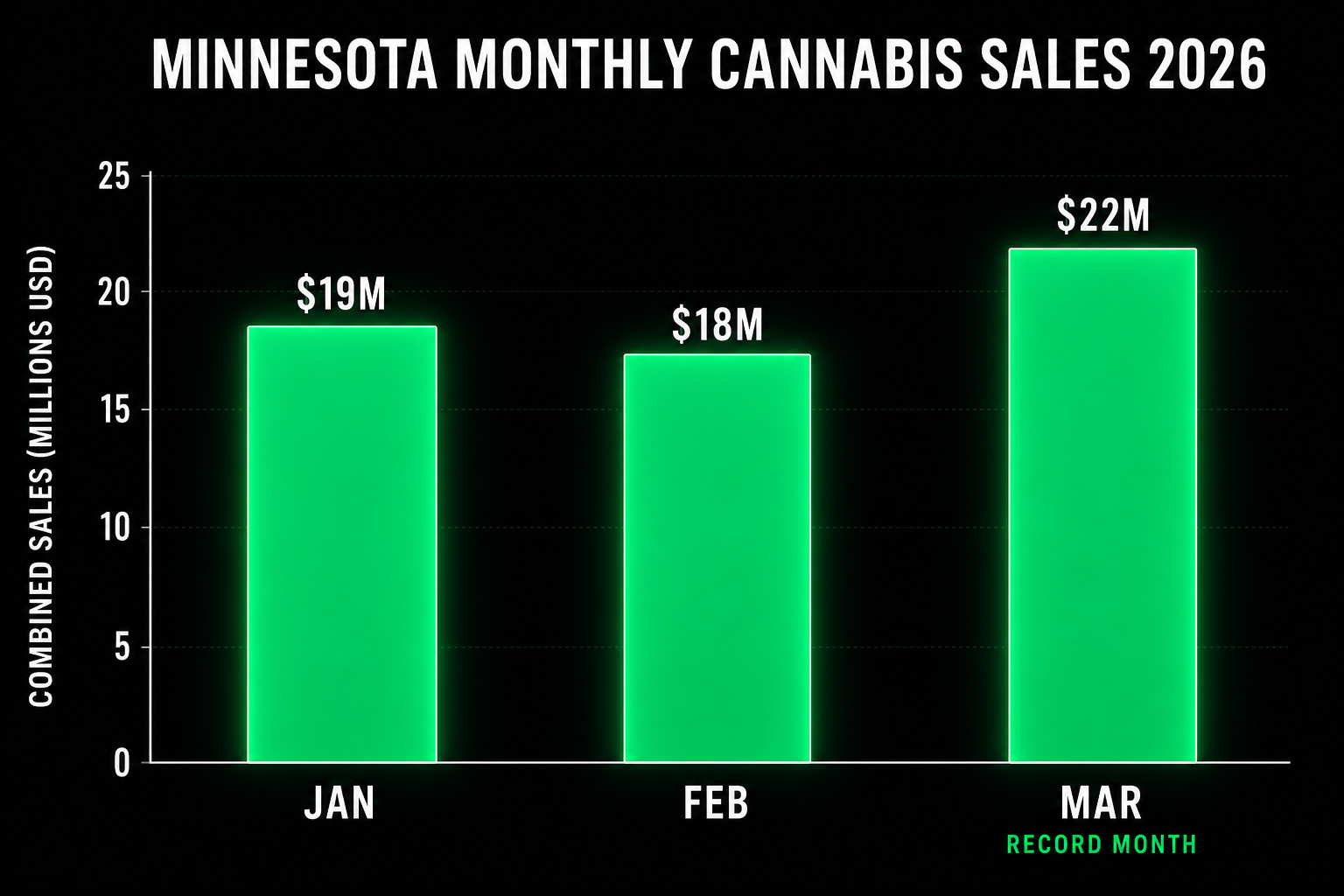
The market keeps grinding upward. Through the end of April 2026, Minnesota's adult-use channel has done roughly $60 million in sales for the calendar year, with the medical program adding about $36.8 million on top, according to figures compiled from the OCM's Cannabis Market Monitor and reported by MJBizDaily. March 2026 briefly held the single-month record at roughly $22 million combined, then April came in at $25 million and broke it again. The trend line hasn't just held; it's accelerating.
| Period | Adult-Use | Medical | Combined |
|---|---|---|---|
| January 2026 | ~$10.3M | ~$8.8M | ~$19.1M |
| February 2026 | ~$9.7M | ~$8.1M | ~$17.8M |
| March 2026 | ~$14M | ~$8M | ~$22M |
| April 2026 | ~$17M | ~$8M | ~$25M ← new record |
| 2026 YTD (through April) | ~$60M | ~$25M | ~$85M |
OCM Executive Director Eric Taubel has said he expects monthly sales to roughly double as more licensed operators come online, and MJBizDaily still projects full-year 2026 adult-use sales near $430 million. To hit that, the gap between licenses issued and shelves stocked has to close. As of the spring dashboards, Minnesota had around 148 operating dispensaries and a licensed footprint that keeps expanding, but most operators are still working with thin inventory and limited strain variety. For context: Minnesota may approach 200 operating dispensaries by end of 2026, compared to just 148 when April's record sales dropped.
The constraint, as it has been all year, is supply. Wholesale flower is still trading well above $4,500 per pound, and industry estimates put canopy utilization at under 20% of the roughly 2 million square feet the market needs at maturity. The math on pricing flows straight from that bottleneck, which we get into below.
The Big One: Minnesota's 2026 Cannabis Omnibus Bill
This is the story of the month, and honestly of the year so far. In the closing hours of the 2026 session, the legislature passed a cannabis policy omnibus bill (SF 4401) that Gov. Walz signed into law. It is the most significant rewrite of Minnesota's cannabis framework since the original 2023 legalization act. Here's what it actually does, in plain language.
Medical and Adult-Use Supply Chains Merge
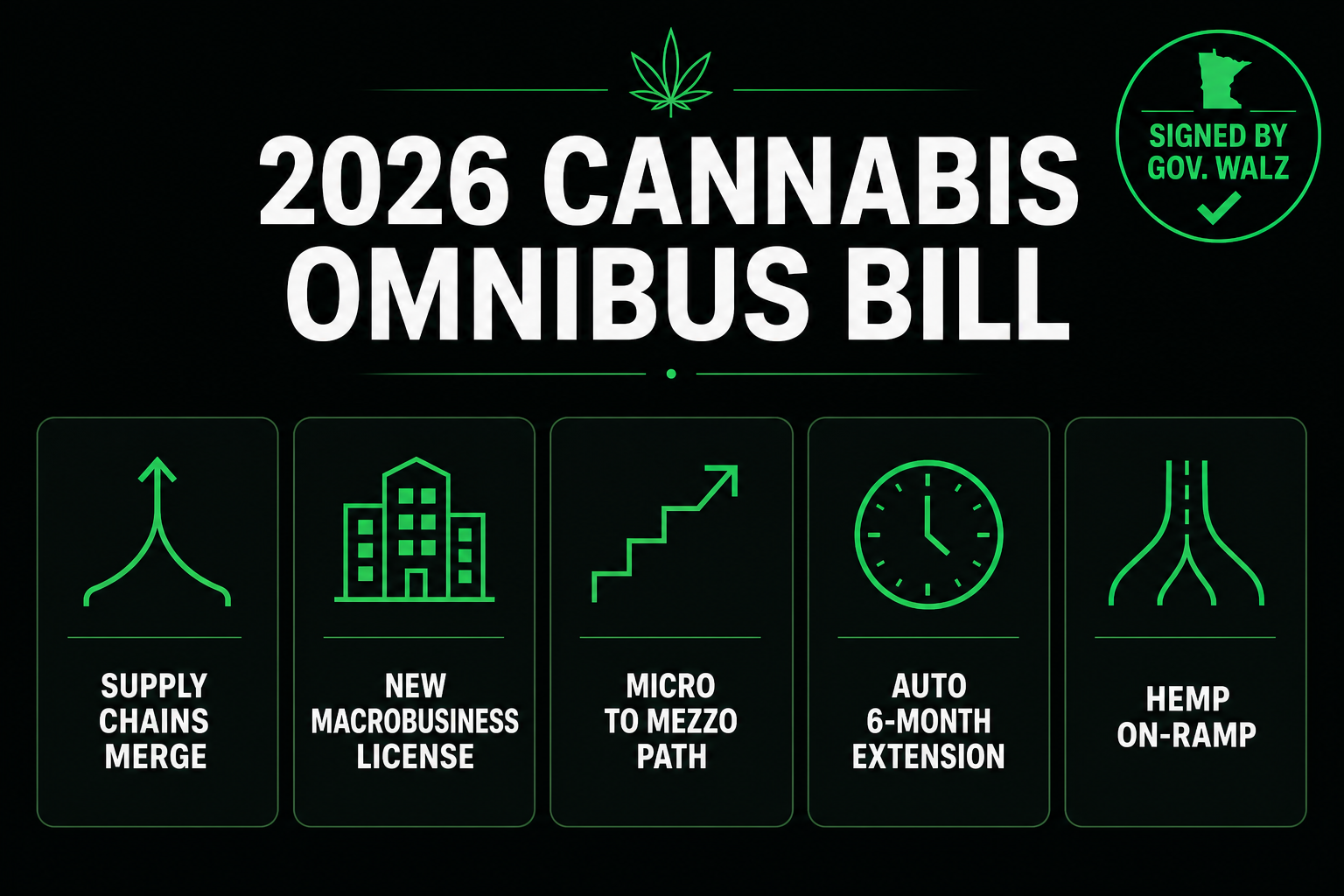
The biggest structural change: Minnesota is collapsing its two parallel supply chains into one. Going forward, medical and adult-use product can move through shared cultivation, manufacturing, and inventory systems under a single seed-to-sale tracking regime. For years the medical program operated as a walled garden run by two vertically integrated operators. That wall is coming down, which should improve medical product availability and selection while giving the broader market more supply to work with. (MJBizDaily; MPR News)
A New "Macrobusiness" License Replaces Medical Combination
The bill phases out the old medical combination license and replaces it, effective January 1, 2027, with up to eight new macrobusiness licenses. These larger operators face an indoor canopy cap of 38,000 square feet, down from the 90,000 the medical combination businesses had, can run up to eight retail locations, and must hold at least two medical endorsements and serve areas with high medical need. It's a deliberate rebalancing, shrinking the giants while keeping medical access intact. (Foley Hoag analysis)
Micro Can Ramp to Mezzo, If You Play in Medical
One of the most-discussed provisions for small operators: a microbusiness can scale up to mezzobusiness size, but the on-ramp is tied to participating in the medical market. The state is using the carrot of growth to pull capacity toward medical patients, who have struggled with selection under the old two-operator system. (North Star Cannabis Consulting)
Everybody Gets More Time to Open
Every licensee now receives an automatic six-month extension to begin operating, with the possibility of a second six-month extension after that. If you've been tracking the pipeline, you know why this matters: hundreds of approved operators have been stuck trying to secure real estate, capital, and product. This buys the whole class of stalled licensees breathing room without forcing OCM to play whack-a-mole with individual deadlines. (North Star Cannabis Consulting)
The Hemp-to-Adult-Use On-Ramp
The bill formalizes something that's been happening informally for a while: it lets hemp and cannabis worlds share ownership, share premises and equipment, and it allows "ratio" hemp-derived CBN products to be sold inside licensed dispensaries. Combined with the supply-chain merger, this is the clearest signal yet that Minnesota intends to fold its enormous hemp economy into the regulated cannabis system rather than let the November federal ban simply wipe it out. More on that convergence below.
Navigating OCM Regulations?
The omnibus bill changes a lot for operators. Whether you're a hemp retailer eyeing the regulated market or a microbusiness mapping your path to mezzo, our Business & OCM Guides break it down.
Read the GuidesRetail Dominance: Kwik Trip and Target Are Eating the Hemp THC Market
Here's the tension nobody at the small-dispensary level wants to say out loud: the two biggest hemp THC retailers in Minnesota right now are a gas station chain and a big-box store. Minnesotans, who have trusted Kwik Trip with their gas, their glazers, and frankly major life decisions for decades, can now also trust it with their 5mg THC seltzer. This is either a triumph of market access or a sign that we've officially lost the plot, depending on who you ask.
According to a review of OCM data, Kwik Trip holds the most lower-potency hemp edible (LPHE) licenses in the state, with 225 locations. Target is right behind at No. 2, having licensed all 72 of its Minnesota stores to sell THC drinks and edibles as of April 1, 2026, after a successful 10-store pilot. Target's initial lineup leans on established Minnesota and national beverage brands like Cann, Wyld, Indeed, Surly, Birdie, and Trail Magic. (Milwaukee Business Journal; Marijuana Moment)
For consumers, this is convenience: you can grab a 5 mg THC seltzer with your groceries. For the licensed dispensary down the street, it's a structural threat. Hemp THC beverages were supposed to be a gateway that funneled curious consumers toward dispensaries. Instead, the gateway is increasingly the checkout lane at a store they already shop at. The omnibus bill's hemp-to-adult-use on-ramp may eventually pull some of this volume into the regulated channel, but for now the big-box and convenience players own the shelf.
It's worth keeping the two markets straight. The Kwik Trip and Target footprint is hemp-derived THC under the LPHE rules (max 5 mg per serving, 10 mg per beverage). The licensed dispensaries we track sell the full adult-use product line. Both are legal. They just live under different rules and, for now, different roofs. If you want to see who's actually open on the dispensary side, our directory tracks live menus statewide.
The Testing Crisis Just Got Worse: Legend Frozen
We've been calling testing capacity the quiet chokepoint on this market since February's report. In May it stopped being quiet.
OCM ordered Legend Technical Services, a St. Paul lab that was one of only a handful fully licensed to do all required cannabis and hemp testing, to halt testing. The agency had licensed Legend in September 2025 under a set of variances that let it keep using its medical-era methodologies so the recreational market would have enough testing capacity at launch. Those variances expired, and OCM said Legend had not addressed outstanding "security and testing requirements." As a direct result, the lab is returning more than 400 samples to clients, and Minnesota is back down to three fully licensed testing labs for the entire industry. (Star Tribune; Ganjapreneur; Cannabis Equipment News)
OCM spokesman Josh Collins framed it as a matter of holding everyone to the same bar: "Our commitment to public health and safety requires us to hold all license holders to the same standards." Legend's vice president said the company had submitted most of the requested information and expected to provide the rest quickly, but there's no timeline yet for resuming work. The lab can be reinstated once it clears the issues.
Two more pieces of the testing story:
- A new lab is coming online. PhytoLab, a veteran-owned facility in Chisago City just north of the Twin Cities, has been licensed as Minnesota's sixth cannabis testing facility, though for now its scope is limited to potency and microbial testing. It's incremental relief, not a fix. (Star Tribune "Nuggets"; North Bloom)
- The outdoor season is at risk. OCM's pre-operational review (FPOR) backlog is bumping up against the planting calendar, and outdoor cultivators warn they could miss their window if approvals don't move. For a market starved of canopy, losing an outdoor season would sting. (North Star Cannabis Consulting)
The throughline hasn't changed: not enough labs, too much product, and a single disruption ripples all the way to the dispensary shelf. The out-of-state testing extension Gov. Walz signed in March (good through May 2027) is doing real work right now to keep hemp product moving while in-state capacity rebuilds.
Looking for a Cannabis Job in MN?
From lab techs to budtenders to cultivation crews, the MN cannabis workforce is expanding fast. We maintain the largest database of Minnesota cannabis-focused jobs.
Browse Cannabis JobsHemp Meets Adult-Use: The Line Is Disappearing
Step back and the throughline of May is convergence. For four years Minnesota ran two separate cannabis economies: a regulated medical and adult-use system on one side, and a sprawling $180 to $200 million hemp-derived THC market on the other, spread across thousands of retailers. The omnibus bill takes a sledgehammer to the wall between them.
Shared ownership means one operator can now hold both cannabis and hemp interests. Shared premises and equipment means the same facility can serve both channels. And allowing "ratio" hemp CBN products inside dispensaries means the product lines themselves start to overlap on the shelf. Add the merged supply chain, and you get a single, larger market instead of two adjacent ones.
The timing is not an accident. The federal hemp ban scheduled for November 12, 2026 threatens to outlaw the high-dose hemp THC products that built that $180 to $200 million market. By building an on-ramp now, Minnesota is giving hemp operators a regulated lifeboat before the federal tide comes in. Whether enough of them can afford the climb into the licensed system is the open question, but the door is officially open.
This is also where the next consumer-education wave is forming. Newsletters across the state are now calling CBG (cannabigerol) "the next CBD" as the wellness conversation moves beyond THC and CBD into minor cannabinoids. Expect to see more CBG and CBN "ratio" products marketed on a functional, wellness-first basis, especially as those products gain a clear path onto dispensary shelves. (Cannaverse by Canna Connect)
Federal vs. State: The Storm Cloud Hasn't Moved
The biggest decision still hanging over this market is being made in Washington, not St. Paul. Which is a polite way of saying: Congress, a body that has not historically moved fast on anything, is the last line of defense between Minnesota's $180–200M hemp economy and a federal ban in November. No pressure.
The Federal Hemp THC Ban (November 12, 2026)
A federal provision signed in late 2025 will, starting November 12, 2026, ban hemp-derived products containing more than 0.4 mg of total THC per container. (Update, Oct. 7, 2026: most of this federal change now takes effect Dec. 11, 2026, delayed from Nov. 12 by H.R. 6500.) Minnesota law currently allows up to 5 mg per serving in edibles and 10 mg per can in beverages. The gap between those numbers is the entire hemp THC beverage category. At stake: a $180 to $200 million hemp economy, roughly $16 million in annual state tax revenue, and the 1,500-plus licensed hemp businesses now operating under state law, plus the big-box and convenience retailers betting hard on the category.
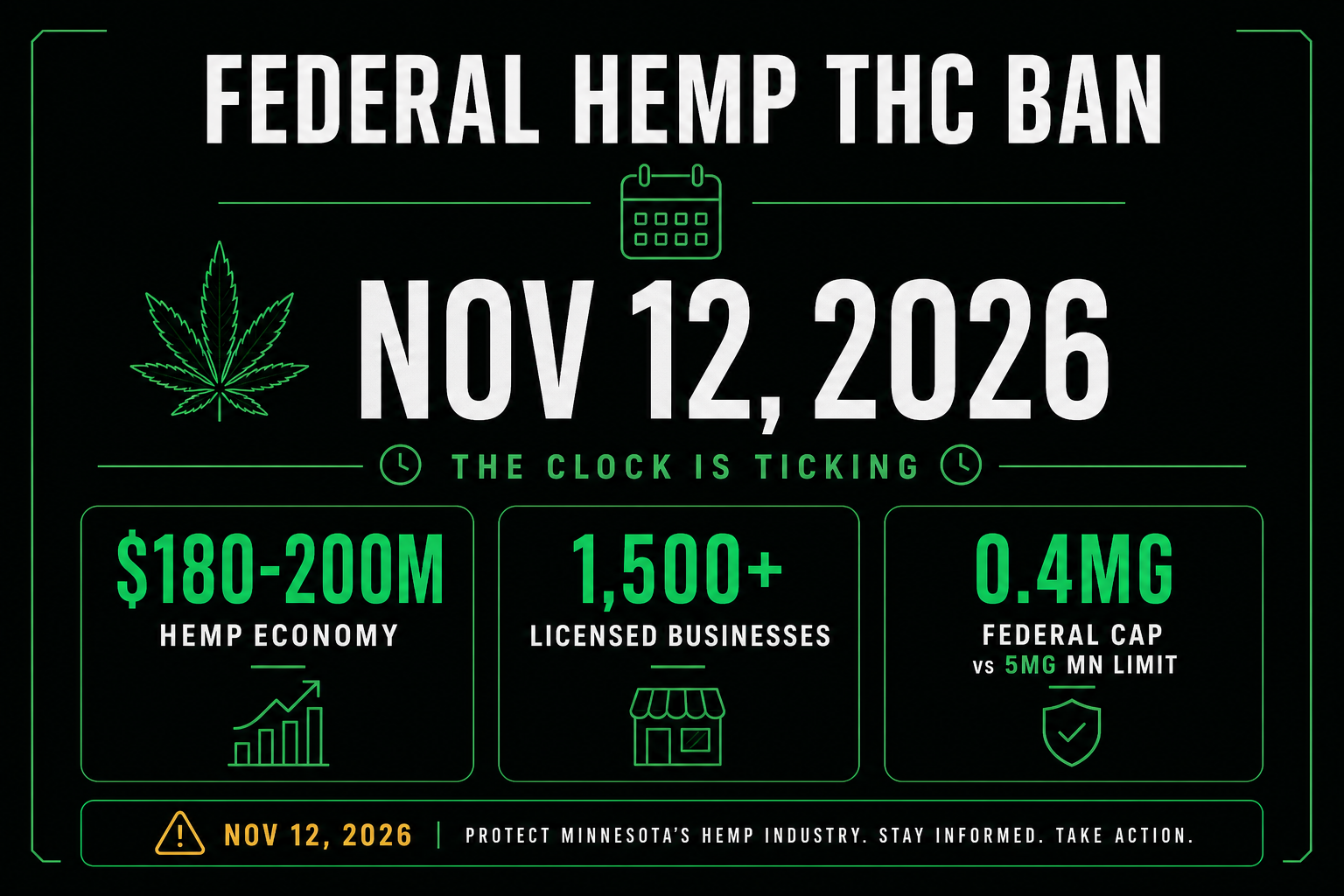
There's a bipartisan federal fix in play to delay the ban, but as of the end of May it has not passed either chamber. Distributors typically start pulling product 60 to 90 days ahead of an effective date, which means real shelf impact in Minnesota could begin as early as August or September if Congress doesn't act. This is the single biggest variable for the back half of 2026.
Cannabis Clemency Push
On the criminal-justice front, a group of 29 Democratic lawmakers is pressing President Trump to commute the sentences of people serving federal time for cannabis offenses, a reminder that the policy fight runs well beyond commerce. (Star Tribune "Nuggets")
The Federal-State Conflict Scorecard
| Issue | Federal | Minnesota | Conflict |
|---|---|---|---|
| Adult-use legality | Illegal (Schedule I) | Legal for 21+ under Ch. 342 | High |
| Hemp-derived THC | Banning over 0.4mg/container Nov 2026 | Legal to 5mg serving, 10mg can | High, imminent |
| Section 280E | Applies until final DEA rule | Decoupled at state level | Medium |
| Banking | FDIC restricts cannabis services | No state-level fix | Medium |
| Interstate commerce | Prohibited even between legal states | Cannot import or export | High |
| Tribal compacts | NIGC oversight | Compacts signed by Walz | Low, cooperative |
Track the Bills Live
Curious where the omnibus provisions, the federal hemp fix, or THC potency caps stand? Use our live bill tracker to follow what's moving in real time.
Track MN LegislationThe License Pipeline: Lotteries Land June 5
The first capped-license lotteries (covering cultivator, manufacturer, and mezzobusiness license types) ran in June 2025, with social equity applicants drawn first. The SF 4401 omnibus bill extended the cap deadline from July 1, 2026 to July 1, 2027, giving OCM more runway to issue licenses and opening the door for a second application window post-cap review. A separate retailer track continues to process applications, with OCM data showing a stark bottleneck: roughly 9 retail licenses issued against 854 applicants in the pipeline. (North Star Cannabis Consulting; cann.dev)
This matters because the capped categories are exactly where the supply chain is thinnest. More cultivators and manufacturers in the ground and at the bench is the only durable fix for the pricing and selection problems consumers keep flagging. Pair that with the omnibus bill's automatic extensions, and the pipeline finally has both a starting gun and some slack in the timeline.
On the conference circuit, the NECann cannabis convention came to the Minneapolis Convention Center this spring and drew more than 60 Minnesota speakers, a sign of how quickly the state has become a center of gravity for the industry nationally. (North Star Cannabis Consulting)
OCM Dashboard & Market Data
Want the raw numbers? Our Market Data hub compiles OCM dashboard data, license counts, and sales projections in one place.
View Market DataPricing, Taxes, and the Black-Market Problem
If there's one thing Minnesotans agree on (more than hot dish, more than whether it's a "bubbler" or a "drinking fountain") it's that legal weed is still too expensive. Minnesota remains one of the highest-priced adult-use markets in the country. Average retail flower runs around $13.54 per gram before tax, and once you stack the taxes the all-in cost pushes past $16 per gram in most of the state.
Every licensed purchase carries three layers: the 15% cannabis gross receipts tax, the 6.875% state sales tax, and any local sales tax. In St. Paul, that combined burden runs past 25%. Tribal dispensaries operating under state compacts don't collect the 15% gross receipts tax, which is why a $65 purchase at a tribal location saves you roughly $9.75 versus the same buy at a state-licensed shop. That price gap is a recurring theme in consumer chatter, and it's a big part of why the unregulated market still competes on price. Industry analysts estimate the legal channel has captured only a fraction of total Minnesota cannabis demand so far, with illicit flower still available for around $8 a gram.
You can run your own numbers with our tax calculator, and if you're price-shopping, the deals page tracks current discounts across the state.
Is the Medical Card Still Worth It?
For regular consumers, the medical card math has only gotten more compelling. Medical cannabis is exempt from the 15% gross receipts tax, carries higher possession limits, and now, under the omnibus bill's supply-chain merger, should see better product selection as the medical program stops operating as an isolated channel. The state fee was eliminated back in July 2023, so the main cost is the evaluation itself. For anyone buying more than occasionally, the tax savings alone can cover the cost of certification in short order. If you're weighing it, our breakdown of medical vs. recreational in Minnesota lays out the tradeoffs.
The Community Angle: Events, Spotlights, and Advocacy
The Minnesota cannabis story isn't only data and statutes. A few human-interest threads worth flagging from the month:
- Community spotlights. Industry newsletters highlighted Kim Bruen of Zen Den, who's building people-first HR practices for cannabis businesses, and Kayla Fearing of Healing Fear Consulting, who helped pass Minnesota's 2024 Caregiver Law. (Cannaverse by Canna Connect)
- Banking access. Union Bank & Trust drew attention for its work on financial access and compliance for an industry still largely locked out of mainstream banking, an ongoing pain point with no federal fix in sight.
- A statewide beverage launch. The Green Standard, a 5 mg THC beverage, went statewide through the GRD wholesale portal, an example of how fast the beverage category is professionalizing its distribution.
- OCM on the road. The agency's listening tour is heading to Bemidji and Duluth, continuing its push to gather feedback from greater Minnesota, where access still lags the metro. See our business and OCM guides and the OCM site for details.
- Upcoming gatherings. Regional industry events are scheduled for Brainerd (July 30) and Duluth (October 15), and Art-A-Whirl in northeast Minneapolis hosted the first licensed cannabis event earlier in the month.
There was also a sobering reminder of why packaging and enforcement rules exist: in Moorhead, parents were charged with felonies after a dozen middle schoolers were sickened by drug-laced "candy," and Minnesota schools are rolling out new cannabis education curriculum in response. Legalization comes with real public-health responsibilities, and the state is still figuring out the guardrails.
What I'm Watching for June
A few things I'll be tracking between now and the next report:
The June 5 license lotteries and how many cultivator and manufacturer slots actually convert toward real capacity. Whether OCM clears its FPOR backlog in time to save the outdoor growing season. How fast Legend Technical Services gets reinstated, and whether the testing pipeline stabilizes or tightens further. Any federal movement on the hemp ban fix, because the calendar is starting to compress toward that August-September distributor pull. And the first signs of how operators respond to the omnibus bill, especially hemp businesses weighing the on-ramp into the regulated market and microbusinesses eyeing the path to mezzo.
If you're an operator with a story we should be covering, hit reply on the email version of this report and tell me what's actually happening on the ground.
Frequently Asked Questions
What did Minnesota's 2026 cannabis omnibus bill do? The 2026 cannabis omnibus bill (SF 4401), signed by Gov. Walz, merges Minnesota's medical and adult-use cannabis supply chains into one system, replaces the medical combination license with up to eight new "macrobusiness" licenses effective January 1, 2027, lets microbusinesses scale to mezzobusiness size if they participate in the medical market, gives every licensee an automatic six-month extension (with a possible second) to begin operating, and creates an on-ramp for hemp operators through shared ownership, shared premises, and "ratio" hemp CBN products in dispensaries.
Why was Legend Technical Services shut down? Minnesota's Office of Cannabis Management ordered Legend Technical Services, a St. Paul testing lab, to halt testing after the variances it was licensed under in September 2025 expired and the lab had not resolved outstanding security and testing requirements. Legend is returning more than 400 samples to clients and can be reinstated once it addresses the issues. The freeze leaves Minnesota with three fully licensed cannabis testing labs.
Who has the most THC licenses in Minnesota? Kwik Trip holds the most lower-potency hemp edible (LPHE) licenses in Minnesota, with 225 locations, according to a review of OCM data. Target is second, having licensed all 72 of its Minnesota stores to sell hemp-derived THC drinks and edibles as of April 1, 2026. These are hemp-derived THC retail licenses, distinct from full adult-use dispensary licenses.
When are the Minnesota cannabis license lotteries? The first capped-license lotteries are scheduled for June 5, 2026, covering cultivator, manufacturer, and mezzobusiness license types, with social equity applicants drawn first. A separate general retailer lottery is expected later in the summer of 2026.
Is the federal hemp THC ban still happening in November 2026? As of the end of May 2026, the federal provision banning hemp-derived products with more than 0.4 mg of THC per container is still scheduled to take effect November 12, 2026, and no federal fix to delay it has passed Congress. (Update, Oct. 7, 2026: most of this federal change now takes effect Dec. 11, 2026, delayed from Nov. 12 by H.R. 6500.) Because distributors typically pull product 60 to 90 days ahead of an effective date, Minnesota shelf impact could begin as early as August or September if lawmakers don't act.
Is a Minnesota medical cannabis card worth it in 2026? For regular consumers, often yes. Medical cannabis is exempt from the 15% cannabis gross receipts tax, carries higher possession limits, and should see improved product selection now that the omnibus bill merges the medical and adult-use supply chains. The state registration fee was eliminated in July 2023, so the main cost is the evaluation, which the tax savings can offset quickly for frequent buyers.
What is CBG and why is it being called "the next CBD"? CBG (cannabigerol) is a minor cannabinoid that the industry is increasingly marketing on a wellness, functional basis. As consumer education moves beyond THC and CBD, and as the omnibus bill clears a path for "ratio" hemp products in dispensaries, CBG and CBN products are positioned as the next growth area in the wellness cannabinoid conversation.
Sources
All sources below are primary documents, official press releases, or named reporting from established outlets and industry newsletters.
- Minnesota OCM Cannabis Market Monitor, sales and license dashboards.
- MJBizDaily, "Minnesota merges medical and adult-use cannabis supply chains," May 2026, and 2026 sales reporting.
- MPR News, Minnesota cannabis and hemp omnibus coverage, May 28, 2026.
- Foley Hoag, Cannabis and the Law, "Minnesota Governor Walz Signs Landmark Cannabis Omnibus Bill," May 2026.
- Star Tribune, "Major Minnesota cannabis testing facility told to pause work over licensing issues."
- Ganjapreneur, "Minnesota Regulators Freeze Cannabis Testing Lab's License."
- Cannabis Equipment News, "One of Minnesota's Few Cannabis Testing Facilities Has Been Shut Down."
- Milwaukee Business Journal, "Kwik Trip leads Minnesota THC market as Target hits No. 2," May 26, 2026.
- Marijuana Moment, "Target Expands Involvement In Hemp THC Drinks Market With 72 New Licenses In Minnesota."
- Minnesota Business, "Target Expands Hemp Beverage Sales Across 72 MN Stores."
- Fox 9, Minnesota cannabis license lottery date reporting.
- Minnesota Department of Revenue, Cannabis Tax, gross receipts tax detail.
- The North Bloom, profile of PhytoLab, Chisago City.
- Star Tribune "Nuggets" newsletter (May 22 & May 29, 2026), PhytoLab licensing, Albert Lea Smoking Tree appeal, federal clemency push, OCM listening tour, Moorhead enforcement, Art-A-Whirl event.
- North Star Cannabis Consulting newsletter (May 28, 2026), 2026 omnibus bill breakdown, FPOR backlog, NECann conference.
- Cannaverse by Canna Connect newsletter (May 20 & May 27, 2026), CBG consumer education, community spotlights, The Green Standard beverage launch, Union Bank & Trust banking spotlight.
This report is published by MN Cannabis Hub for informational purposes. All data and claims are sourced from primary government documents, official press releases, named reporting at established outlets, and industry newsletters. Nothing in this report constitutes legal, tax, financial, or investment advice.
Got a tip, a correction, or a story we should be covering? Reply to the newsletter or reach out through mncannabishub.com. We read everything.
See you in June.
Jaycub