State of the Minnesota Cannabis Market - March 2026 Report
January adult-use sales hit $10.3M as the market eyes a $430M projection. Dive deep into the supply constraints, licensing acceleration, missing hemp channels, and why Red Lake Nation might be the wholesale savior.
Minnesota's adult-use cannabis market is 18 months into legalization and six months into real retail sales, and the tension between its enormous potential and its structural constraints has never been more visible.
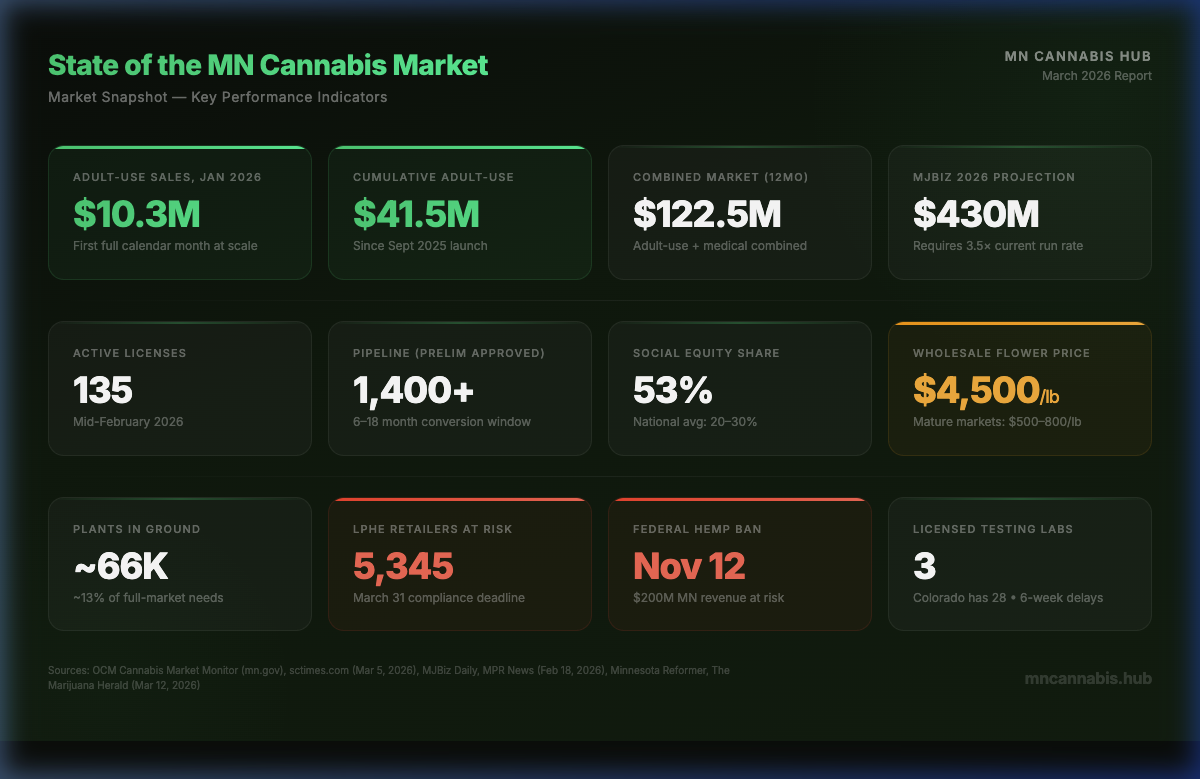
January 2026 posted $10.3 million in adult-use sales, bringing the cumulative total since the September 2025 launch to $41.5 million. The 12-month combined market (adult-use plus medical) clocked $122.5 million. MJBiz projects $430 million in adult-use sales for full-year 2026. The math works, but only if the supply chain catches up, the federal hemp situation resolves, and the licensing pipeline converts at scale.
Three storylines define March 2026:
- The March 31 LPHE deadline that will restructure the $180-200M hemp market overnight.
- The November 12, 2026 federal hemp-derived THC ban that puts $200 million in Minnesota retail revenue at risk.
- The THC potency cap legislation (SF 4434) that threatens to reshape the product shelf before the market even finds its footing.
Meanwhile, tribal nations are quietly solving the supply crisis on their own terms, the OCM just launched its first statewide listening tour, and the license pipeline (now at 135 active with 1,400+ in preliminary approval) signals an industry still in the early innings of scale.
Looking for a Cannabis Job in MN?
We maintain the largest and most up-to-date database of Minnesota cannabis-focused jobs. From budtending to cultivation, find your path into the industry today.
Browse Cannabis Jobs1. Sales Dashboard & Revenue Run-Rate
Minnesota launched adult-use retail on September 17, 2025. Here is every data point available through January 2026:
| Period | Adult-Use Sales | Notes |
|---|---|---|
| Sept 17 - Dec 2025 (combined) | $31.1M | 466,000-500,000 transactions |
| January 2026 | $10.3M | OCM Market Monitor (via sctimes.com) |
| Cumulative through Jan 2026 | $41.5M | All adult-use retail since launch |
| February 2026 | Not yet released | Expected mid-April via OCM dashboard |
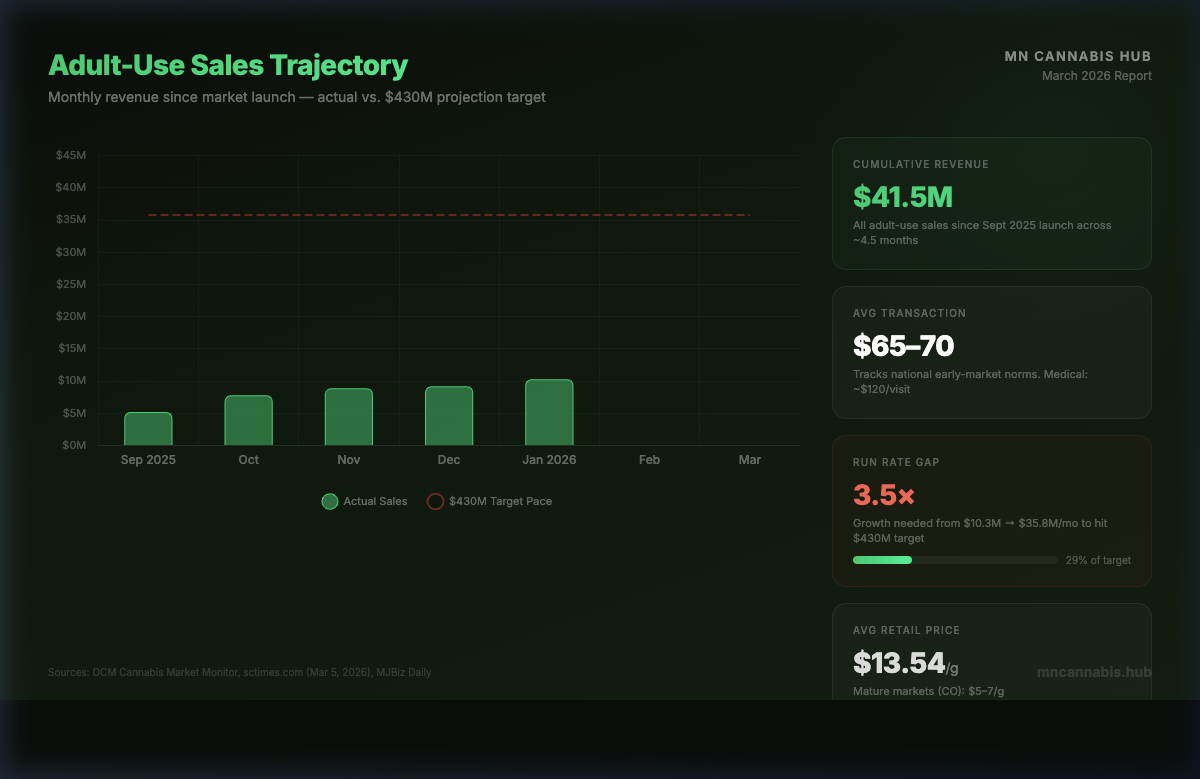
At $10.3M per month, annualized adult-use revenue lands around $124M, less than 30% of the $430M MJBiz projection. Closing that gap requires one thing above all others: more stores, with more product on shelves.
Average Ticket and Pricing
- Average transaction value: $65-70 adult-use ($120 medical)
- Average retail price: $13.54/gram (Colorado averages $5-7/gram)
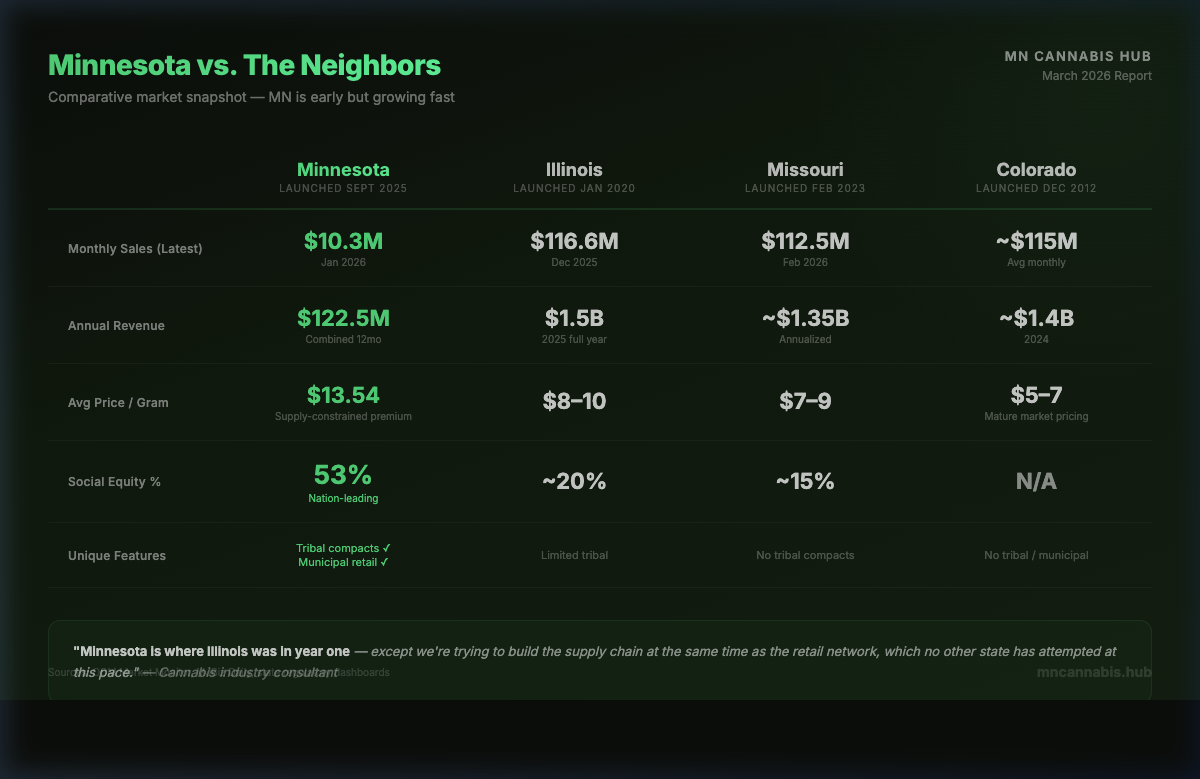
"Minnesota is where Illinois was in year one - except we're trying to build the supply chain at the same time as the retail network, which no other state has attempted at this pace."
, Cannabis industry consultant, cited in MN trade circles
2. The Acceleration Curve
OCM's licensing pace has been the single most encouraging trendline in the Minnesota market. The ramp from zero to 135 in eight months is steeper than any comparable state.
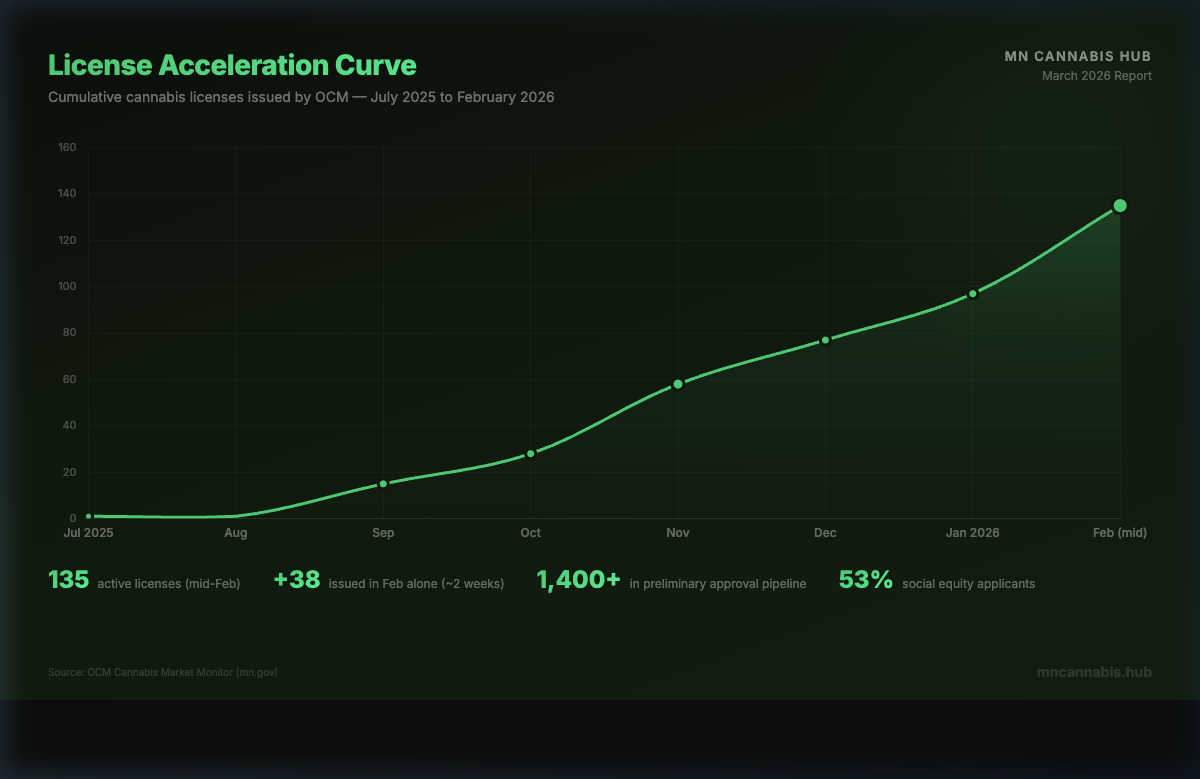
The February surge, 38 licenses in roughly two weeks, signals that OCM has cleared internal bottlenecks.
Social Equity Scoreboard
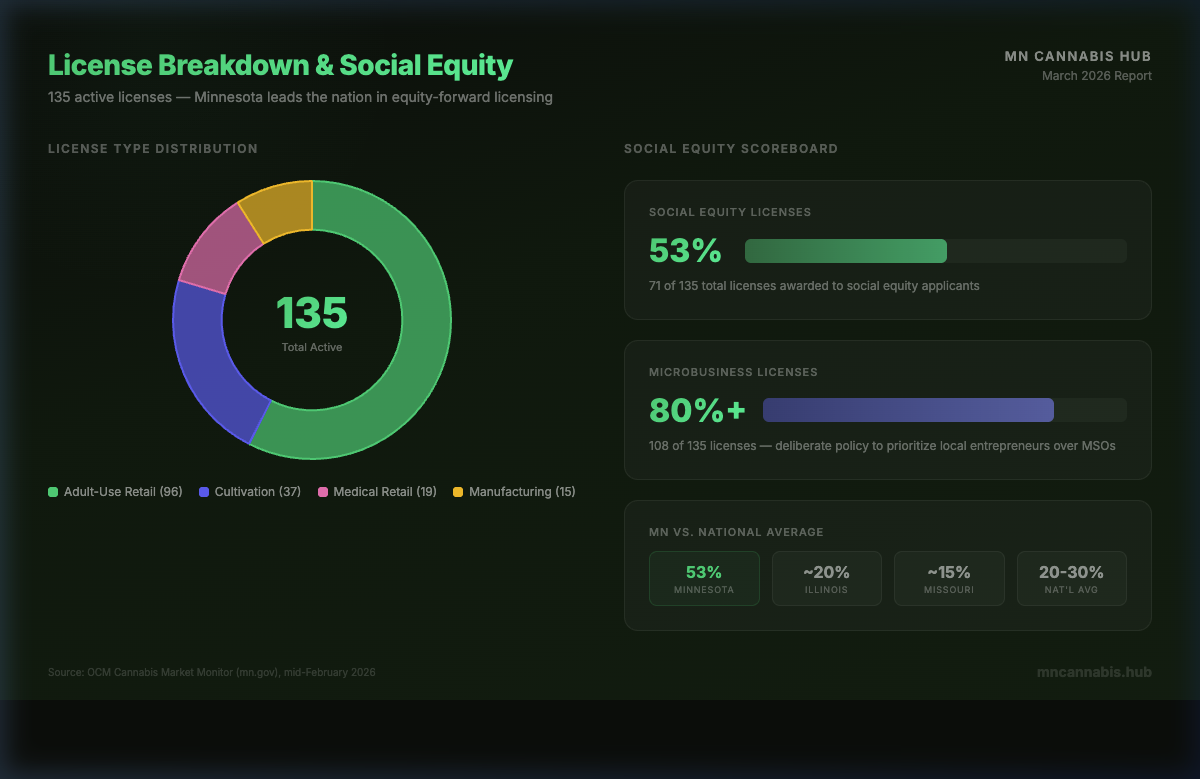
Minnesota leads the nation in social equity cannabis licensing, 53% of licenses awarded to social equity applicants vs. ~25% national average. The microbusiness dominance (80%+ of licenses) reflects deliberate policy design, prioritizing local entrepreneurs over MSOs.
Find an Open Dispensary Near You
Trying to figure out which of these 135 licenses are actually open and selling product? We track every single operational dispensary in the state with live menus and reviews.
View Directory Check Best Deals3. Supply Chain: Still the Chokepoint
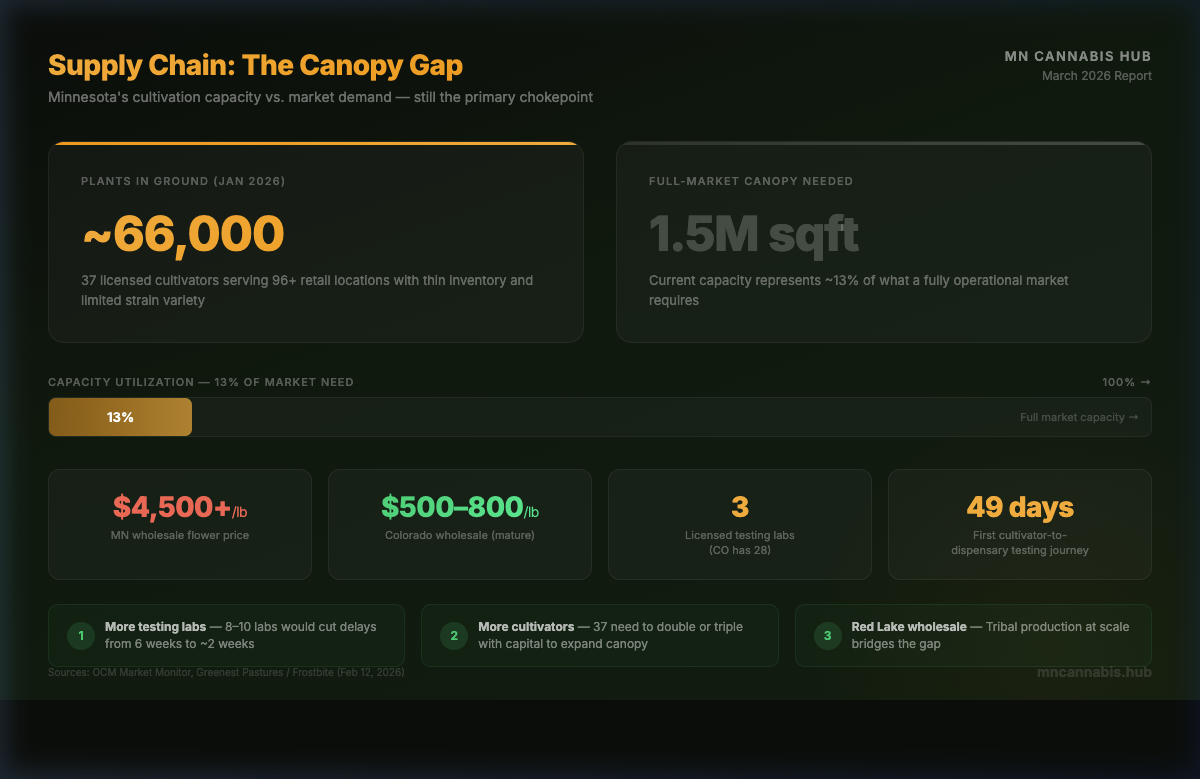
Minnesota's supply constraint is structural, not temporary. Most dispensaries are operating with thin inventory, limited strain variety, and no pricing power with their current suppliers.
The Testing Backlog
Three licensed testing labs serve the entire Minnesota market. The result is predictable:
- 6-week testing delays are standard
- Cultivators cannot move product to market on a timeline that supports retail operations
- The opportunity cost is enormous.
4. LPHE Deadline: The March 31 Cliff
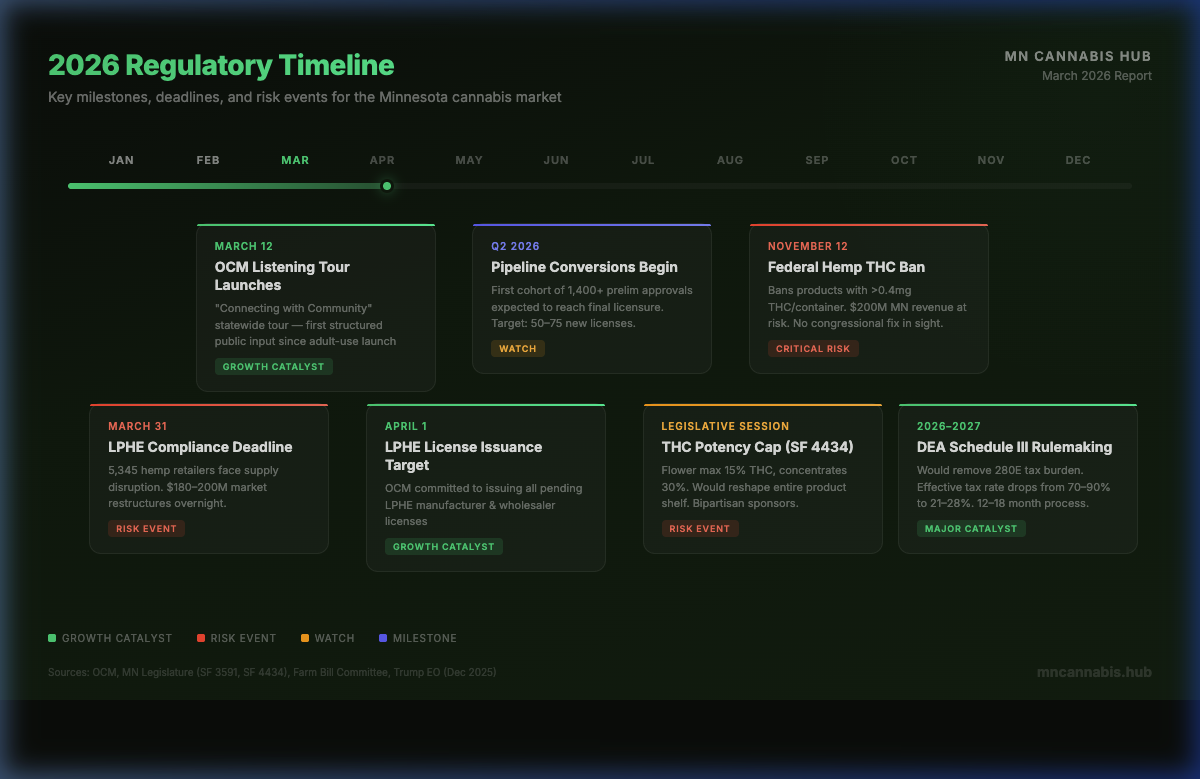
Lower-Potency Hemp Edible (LPHE) manufacturers and wholesalers have operated in a regulatory gray zone since Minnesota legalized hemp-derived THC edibles in 2022. They built a $180-200M per year market.
March 31, 2026 is the end of that era.
5,345 hemp retailers currently operating in Minnesota face the deadline. The OCM has committed to issuing all pending LPHE manufacturer and wholesaler licenses by April 1, 2026. The industry is watching this window closely.
Navigating OCM Regulations?
Whether you're an LPHE hemp retailer making the transition, or a microbusiness looking for compliance tips, our Business & OCM Guides break it all down.
Read the Guides5. The Big One: Federal Hemp Ban vs. Schedule III
On November 12, 2026, federal law bans the sale of hemp-derived THC products containing more than 0.4mg of THC per container. A standard hemp-derived THC gummy contains 5-10mg. Later update: H.R. 6500 became Public Law 119-103 on September 2, 2026, and OCM updated its guidance on September 3, 2026 to reflect a December 11, 2026 effective date. See what the federal hemp change means for Minnesota.
This puts roughly $200M of estimated Minnesota revenue at risk.
At the same time, President Trump signed an executive order directing the acceleration of DEA rescheduling (moving cannabis to Schedule III) and asked Congress to revise the hemp ban provisions. The removal of 280E tax burdens could save mid-size Minnesota operators $2-5M annually. But the paradox remains: schedule relief for licensed cannabis vs. a ban on the hemp side.
6. Tribal Nations: The Supply Solution
On December 18, 2025, Red Lake Nation signed a wholesale distribution compact with the State of Minnesota, becoming an authorized wholesaler to all state-licensed cannabis retailers.
Red Lake has operational cannabis infrastructure, cultivation experience from its tribal dispensary program, and none of the startup overhead that new state-licensed cultivators face. If Red Lake scales its cultivation to meet wholesale demand, it could materially close the supply gap while state-licensed cultivators build out their canopy.
In parallel, Bois Forte Band secured a compact allowing up to 8 off-reservation dispensary locations, a major move to expand rural access in current cannabis deserts.
7. Regulatory Pulse & 2026 Timeline
THC Potency Cap Legislation (SF 4434)
Active in the Minnesota legislature as of mid-March 2026 is SF 4434, a bipartisan bill that would cap flower at 15% THC and concentrates at 30%. It heavily expands required warning labels and would fundamentally alter product lineups currently available at retail.
Track the Bills Live
Curious about SF 4434 or other legislative tweaks to the original legalization bill? Use our live tracker to monitor where the bills are in committee and how they impact you.
Track MN LegislationClosing Note
Minnesota's cannabis market is still in its early adolescent phase, old enough to have real revenue, young enough to be structurally limited in almost every direction.
The bones are good: a strong social equity framework, accelerating licensing, tribal partnerships, and a licensing pipeline that signals long-term scale. The growing pains are real: supply constraints, testing backlogs, federal uncertainty, and an activist legislature.
Minnesota isn't Illinois yet. It isn't Missouri. But it's further along than it looks, and the 1,400+ businesses waiting in the pipeline suggest that operators overwhelmingly believe in the destination.
Report prepared by MN Cannabis Hub. All projections are forward-looking estimates. Past performance does not guarantee future results. This report is for informational purposes and does not constitute investment advice.
Buying regularly? Compare adult-use and medical costs
$99 with code MNHUB. Provider certification comes before OCM enrollment review.
Explore Related Topics
Legal & Compliance
Minnesota cannabis laws, possession limits, and compliance information
Explore Legal & ComplianceDispensary Directory
Find licensed cannabis dispensaries across Minnesota
Explore Dispensary DirectoryPrices & Value
What cannabis actually costs in Minnesota: live menu prices, taxes, and price drops
Explore Prices & ValueGet the Minnesota Cannabis Brief
Dispensary openings, law changes, practical product guides, and worthwhile deals in one useful email.
Free. No spam. Unsubscribe anytime.
Related Articles
Related research
- Monthly sales
Minnesota adult-use and medical cannabis sales by month from the OCM Market Monitor, with a CSV download.
- Licenses vs open stores
OCM listed 355 issued cannabis licenses on September 1, 2026, but far fewer stores were open. Dated license counts beside the stores we confirmed open, with a map.