Minnesota medical cannabis changes for 2027

A free reading of Office of Cannabis Management Guidance Memos GM-2026-09 and GM-2026-08. Last checked November 13, 2026. Educational information. MN Cannabis Hub sells no cannabis. This is not legal, tax, or medical advice.

Under the 2026 law, effective January 1, 2027, Minnesota’s separate medical and adult-use supply chains merge. Except for select high-medical-need products, a product’s medical or adult-use designation moves to the retail sale. Patients still enroll in the registry, still consult a pharmacist or certified medical cannabis consultant, and enrollment is still valid for three years. A registered patient who buys from a business with a medical cannabis retail endorsement stays exempt from the cannabis excise tax. Businesses that operate in both supply chains have their inventories consolidated into one primary Metrc facility.

Countdown

January 1, 2027

Counting to the start of January 1, 2027, Central time

GM-2026-09 calls January 1, 2027, the streamlining effective date and does not name an hour. This countdown uses the start of that date in Central time (America/Chicago). Last checked November 13, 2026.

What changes for me on January 1, 2027?

Pick the role that matches you. Each line is a plain-language reading of OCM’s memo, with the section it comes from.

Enrollment, the pharmacist or CMCC consult, the three-year enrollment period, and the excise-tax exemption at a medical retail endorsement stay. The medical designation of most products moves to the sale.

What changes

  • Except for select high-medical-need products, a product’s medical or adult-use designation is determined at the retail sale, not when it is cultivated or manufactured. The memo says this takes effect January 1, 2027. GM-2026-09, Background
  • A cannabis product is designated medical cannabis once it is sold to a registered patient or caregiver. GM-2026-09, What changes
  • A regulated product sold to a registered patient or registered caregiver must have both a patient-specific label and the medical cannabis symbol. If the symbol is not already on the label, the retailer applies it at the sale, along with the patient-specific label. GM-2026-09, Medical cannabis retail endorsement, labeling
  • A business with a medical cannabis retail endorsement must give enrolled patients and caregivers priority service and keep patient consultations available. Microbusinesses, mezzobusinesses, and retailers must carry every high-medical-need product OCM identified and make it available within 24 hours of a request. A macrobusiness must have those products in stock and available for sale. GM-2026-09, Medical cannabis retail endorsement, requirements
  • Effective January 1, 2027, medical cannabinoid products may no longer be formulated with artificially derived cannabinoids. A compliant product manufactured before that date may still be sold if it has not reached its expiration date. GM-2026-09, Medical cannabinoid product formulation
  • The rule limit of 80 percent THC on adult-use vaporized concentrates does not apply to medical cannabinoid vape products sold to registered patients. The retailer is responsible for not selling a patient-restricted product to an adult-use customer. GM-2026-09, Medical cannabinoid product distinctions for retailers
What stays the same

  • You still enroll in the medical cannabis registry and consult a pharmacist or certified medical cannabis consultant before you are eligible to buy medical cannabis. Enrollment is still valid for three years. GM-2026-09, What stays the same
  • When you buy cannabis flower or cannabis products from a business with a medical cannabis retail endorsement, you are exempt from the cannabis excise tax. GM-2026-09, What stays the same
  • Products purchased by and for patients must still carry the applicable patient-specific labels and medical cannabis designations. GM-2026-09, What stays the same
  • A business still needs a medical cannabis endorsement, in addition to its cannabis license, to serve registered patients. GM-2026-09, What stays the same
  • The high-medical-need product types in the October 12, 2026 list are not currently approved adult-use product types. OCM says they can only be manufactured and sold by businesses with a medical endorsement. GM-2026-08, HMN products

High-medical-need products

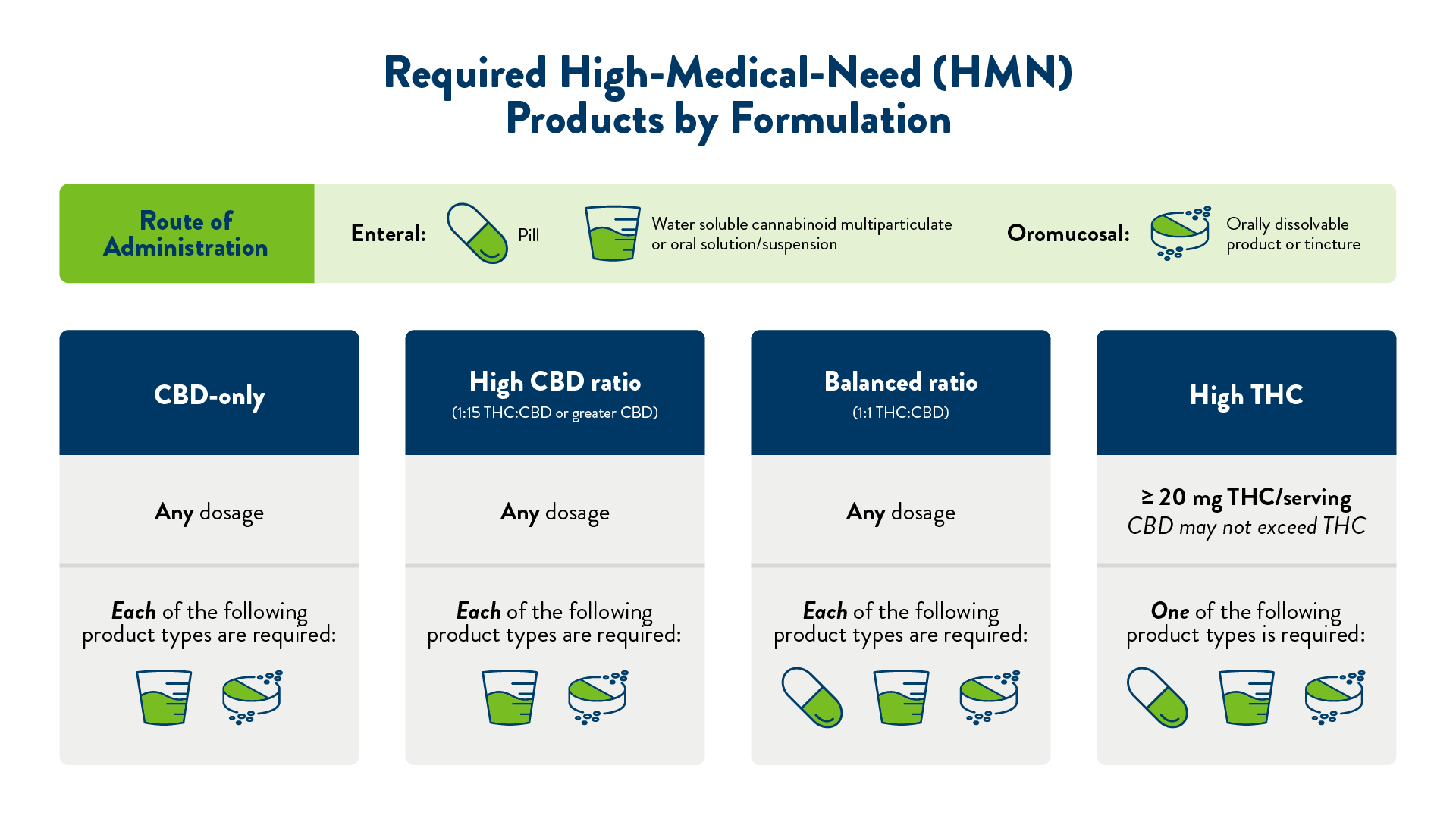
Transcribed from GM-2026-08, dated October 12, 2026. These are formulation and route categories, not brand names. A medical retail location must carry each route listed for CBD-only, high CBD, and balanced products. For the high THC dosage, the memo says the location must carry one of the three routes.

Download CSV

Showing 10 of 10 product types. Source: GM-2026-08, checked November 13, 2026.

High-medical-need product types from OCM Guidance Memo GM-2026-08
FormulationRetail dutyRouteProduct type, as OCM lists itDosage note
CBD-onlyCarry each of these product typesEnteralwater soluble cannabinoid multiparticulate or oral solution/suspensionany dosage (mg per serving)
CBD-onlyCarry each of these product typesOromucosalorally dissolvable product or tinctureany dosage (mg per serving)
High CBD ratio (1:15 THC:CBD or greater CBD)Carry each of these product typesEnteralwater soluble cannabinoid multiparticulate or oral solution/suspensionany dosage (mg per serving)
High CBD ratio (1:15 THC:CBD or greater CBD)Carry each of these product typesOromucosalorally dissolvable product or tinctureany dosage (mg per serving)
Balanced ratio (1:1 THC:CBD)Carry each of these product typesEnteralpillany dosage (mg per serving)
Balanced ratio (1:1 THC:CBD)Carry each of these product typesEnteralwater soluble cannabinoid multiparticulate or oral solution/suspensionany dosage (mg per serving)
Balanced ratio (1:1 THC:CBD)Carry each of these product typesOromucosalorally dissolvable product or tinctureany dosage (mg per serving)
High THC dosage (at least 20 mg THC per serving; CBD may not exceed THC)Carry one of these product typesEnteralpillat least 20 mg THC per serving; CBD may not exceed THC
High THC dosage (at least 20 mg THC per serving; CBD may not exceed THC)Carry one of these product typesEnteralwater soluble cannabinoid multiparticulate or oral solution/suspensionat least 20 mg THC per serving; CBD may not exceed THC
High THC dosage (at least 20 mg THC per serving; CBD may not exceed THC)Carry one of these product typesOromucosalorally dissolvable product or tinctureat least 20 mg THC per serving; CBD may not exceed THC

What this page leaves out

GM-2026-09 says further guidance on high-medical-need areas is forthcoming. This page does not guess which cities or neighborhoods those areas will be. The memo converts medical cannabis combination applicants and license holders to macrobusiness applicants and license holders by January 1, 2027. It does not describe a separate change in “qualified applicant” status, so that phrase is not used as a fact here. The memo body read on November 13, 2026 does not print a publication date for GM-2026-09. GM-2026-08 is dated October 12, 2026.

Related Hub pages: the 2027 transition research hub, the October high-medical-need product guide, and medical-endorsed retail sites. The CSV of the product types is at /data/minnesota-hmn-products-gm-2026-08.csv.

Questions

Sources

Last checked November 13, 2026.