Minnesota Revenue posts October cannabis delivery list
Minnesota Revenue's Oct. 13 cannabis posting list adds 32 newly posted entries and explains when tax-list delivery restrictions apply.
Minnesota Revenue posted a new Cannabis Posting Tax Delinquency List on October 13, adding a current official snapshot of businesses subject to the state's cannabis tax posting rules. The PDF is titled Tax Delinquencies Cannabis Sales and says it is current as of October 12, 2026 at 7:00 p.m.
The practical takeaway is narrower than the PDF looks at first glance. This is not a dispensary menu, a licensing workbook, or a consumer shopping guide. It is a tax compliance list that affects whether listed businesses can receive cannabis product deliveries for resale. Revenue's cannabis posting page says businesses on the list are subject to cannabis tax and are 10 or more days late filing or paying one of several listed taxes and fees.
The October 13 PDF lists 32 newly posted entries with a Non-Delivery Date of September 18, 2026. It also includes 19 recently removed entries, and Revenue's list language says deliveries may resume to businesses in the Recently Removed section. For readers who track Minnesota's retail rollout through the statewide dispensary directory, the key is not to treat the PDF as proof of inventory, hours, licensing status, or whether a specific store is open today.
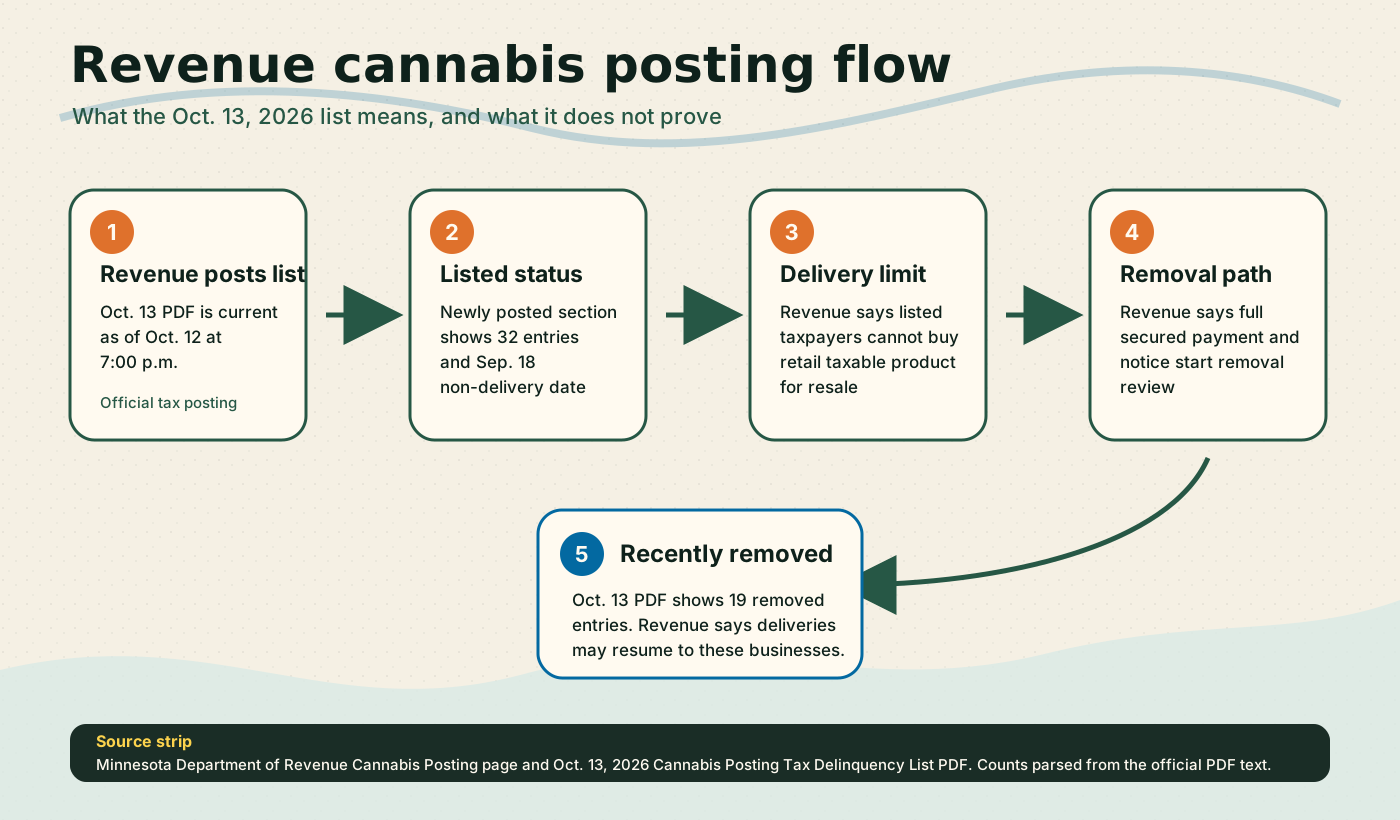
Source note for the visual: the flow uses Revenue's cannabis posting page and the October 13, 2026 PDF. It visualizes the official status path and parsed PDF counts only. It does not identify license status, product availability, store hours, fault, or consumer access for any listed business.
What Revenue posted
Revenue's cannabis posting page describes the Cannabis Posting Tax Delinquency List as a public list of businesses subject to Cannabis Tax that are 10 or more days late filing or paying one of the listed taxes or fees. The page names Sales Tax, Cannabis Tax, Withholding Tax, Corporate Income Tax, S Corporation Tax, and Partnership Minimum Fees.
Revenue says it notifies a business at least 10 days before placing it on the list. It also says the department posts the list and submits it to the Office of Cannabis Management by the 15th day of each month. That timing makes the October 13 PDF a current mid-month compliance document, not a rumor or third-party spreadsheet.
The October 13 PDF is organized into three sections:
- Newly Posted, for taxpayers newly listed under the cannabis posting rule.
- Previously Posted, for names that remain on cannabis posting from previous lists.
- Recently Removed, for businesses that were posted and have been removed.
The newly posted section spans two pages in the extracted PDF text and includes businesses in Bloomington, Burnsville, Cottonwood, Deer Creek, Duluth, East Bethel, Fairmont, Frazee, Golden Valley, Hanley Falls, Hinckley, Hopkins, International Falls, Inver Grove Heights, Lake City, Lamberton, Maplewood, McGrath, Minneapolis, New Brighton, New Hope, Plato, Plymouth, Richmond, Saint Paul, Sebeka, Springfield, and Wood Lake. That geographic spread is why the update is a statewide operator signal, not a single-city item.
What the restriction means
Revenue's page says that beginning the third business day after the list is posted, a listed business cannot purchase retail taxable cannabis products for resale. The same page says no cannabis cultivator, cannabis manufacturer, cannabis microbusiness, cannabis mezzobusiness, medical cannabis combination business, cannabis wholesaler, or industrial hemp grower as defined in state law may sell or deliver any product to a taxpayer included on the posted list.
That language matters because Minnesota's cannabis market is a regulated supply chain. Products move through licensed and regulated business roles before reaching consumers. A tax-list status can affect that movement even when it is not an Office of Cannabis Management licensing action. For broader context on how supply, licensing, and retail access fit together, see the Hub's September state of the market report and the market data dashboard.
It is easy to overstate the point. A Revenue posting does not say a business is closed. It does not say a location is unlicensed. It does not say a consumer broke a law by visiting a store. It says the business is on a tax posting list and that Revenue's cannabis delivery and resale-purchase language applies while the business remains posted.
For shoppers, that should be treated as a caution signal, not a buying recommendation. For operators, it is a counterparty and compliance signal. If a business is on the active list, the delivery restriction language is the fact to care about. If a business appears in the Recently Removed section, Revenue says deliveries may resume, but that still does not prove what is on a shelf.
What changed in the October PDF
The October 13 PDF's most immediate news is the newly posted section. Parsed from the official PDF text, it contains 32 newly posted entries under the September 2026 posting month. The section's header says the non-delivery date is September 18, 2026.
The same PDF also includes a previously posted section, with names that remain subject to cannabis posting from earlier lists. That section is important for operators who need to know whether a name is still active, but it is not the same as a new event. MN Cannabis Hub is treating the October 13 story as a current monthly list update, not as a claim that every previously posted row became newly restricted on October 13.
The Recently Removed section contains 19 entries. Revenue's own PDF language says the names in that section are businesses that were posted and have been removed, and that deliveries may resume to those businesses. One of those entries is Aurora Cannabis LLC / The Prior Lake Dispo, with a removed date of 09/30/2026, which matches the prior Revenue movement covered in the Hub's Prior Lake non-delivery list article. That is a carry-forward in this monthly list, not a brand-new Aurora-only event.
This distinction keeps the article honest. The October document is new. Some rows in it are newly posted. Some rows are continuing. Some rows are recently removed. Those categories should not be collapsed into one headline.
What readers should not infer
The list does not prove a business's current customer-facing status. It does not prove a store's hours, product menu, prices, wait times, ordering options, or whether the business is taking new customers today. It also does not prove that every listed business is an adult-use cannabis dispensary. The list includes businesses subject to cannabis tax rules, and the names include smoke shops, liquor stores, restaurants, wellness businesses, and other retail or cannabis-adjacent entities.
That matters because Minnesota has multiple overlapping cannabis and hemp systems. A reader may see a familiar business name and assume the PDF is an OCM license action. It is not. OCM licensing information belongs in OCM's public sources and in consumer tools such as the Hub's Minnesota cannabis license lookup. Revenue's posting list is a tax and delivery-status source.
The list also does not tell consumers where to buy. If you are planning a legal adult-use purchase, start with a verified licensed retailer, then confirm same-day details with the business. The Hub's first-time dispensary guide and Minnesota FAQ explain basic shopping and legal-use context, but a Revenue PDF should not replace direct store confirmation.
For operators, the caution runs the other direction. Do not rely on screenshots or old saved copies of the PDF. Revenue's page is the current source, and list status can change. If a delivery decision, invoice process, supplier relationship, or compliance review depends on a posting status, check the current official page and save the source you reviewed.
How businesses get removed
Revenue's cannabis posting page says that to avoid being placed on the list, or to be removed from it, a business must pay its tax liability in full using secured funds. The business must notify Revenue after making the payment. Revenue says that after it receives the secured payment in full, it has two business days to remove the business from the list. The page also says removal may be delayed if the business does not tell Revenue it made a payment.
Revenue includes one especially important limitation: payment agreements are not available if the business is subject to Cannabis Tax. That is a plain operational point, not a judgment call from MN Cannabis Hub. If a business has a posting issue, the Revenue page and Revenue contact process are the source to use.
For readers, the removal process explains why a business can appear in one monthly PDF and later move to Recently Removed. It also explains why a status update should be handled as a date-specific fact. A name on an older PDF may not reflect today's status. A recently removed row may restore delivery eligibility under Revenue's language, but it still does not prove inventory reached a shelf.
Why this matters in Minnesota's rollout
Minnesota's cannabis market is still young enough that small supply-chain interruptions can matter. Retail access has expanded, but not evenly. Some communities have licensed retailers open to consumers, some are still waiting on local approvals or buildouts, and some businesses are operating in hemp-derived THC or adjacent retail lanes rather than adult-use cannabis retail.
That is why a tax list deserves careful coverage. It is not as visible as a ribbon cutting, a new menu, or a license announcement. But it is part of the infrastructure that determines whether regulated product can keep moving. The Hub's Minnesota Cannabis Year in Review tracks first-year market milestones, while the tax tracker follows the revenue side of the rollout. The posting list sits between those two worlds: tax compliance on one side, product movement on the other.
The safest reader-facing summary is this: Revenue's October list is a compliance document with real delivery implications. It should be read carefully, category by category, and checked against current official sources before anyone makes a business or shopping decision.
What MN Cannabis Hub will watch next
MN Cannabis Hub will watch for the next Revenue posting update and for any official correction or replacement PDF. If Revenue posts a new version, changes the index link, or updates its cannabis posting page language, this article should be reviewed against the new source.
The second watch item is row-level relevance to licensed adult-use retail. We will not infer license status from a tax row. If a listed business is also a verified OCM-licensed dispensary with a live Hub route, that can justify a narrower follow-up similar to the earlier Prior Lake article. If a row is a smoke shop, restaurant, liquor store, wellness business, or other entity subject to cannabis tax rules, the story may still matter to operators, but it should not be framed as a dispensary availability update.
The third watch item is consumer confusion. If shoppers start treating the PDF as a live menu or as a blacklist, that is exactly the wrong use. The list is useful because it is official and specific. It becomes misleading when readers make unsourced leaps from a tax status to product claims.
Sources
Primary sources checked for this article:
- Minnesota Department of Revenue, Cannabis Posting, checked October 14, 2026.
- Minnesota Department of Revenue, October 13, 2026 Cannabis Posting Tax Delinquency List PDF, checked and parsed October 14, 2026.
- Minnesota Revisor of Statutes, Minnesota Statutes section 270C.726, used for statutory context referenced by Revenue.
- MN Cannabis Hub, Prior Lake Revenue non-delivery list coverage, used to distinguish the October carry-forward row from the earlier Aurora-specific update.
FAQ
Is the October cannabis posting list a dispensary closure list?
No. It is a Minnesota Department of Revenue cannabis tax posting list. Revenue says listed businesses are subject to cannabis tax and are 10 or more days late filing or paying one of the listed taxes or fees. The list can affect resale purchasing and deliveries, but it does not prove a store is closed.
Does a newly posted row mean shoppers cannot buy from that business?
Do not make that leap from the PDF alone. Revenue's language is about listed businesses purchasing retail taxable cannabis products for resale and about regulated suppliers selling or delivering product to listed taxpayers. It is not a live consumer menu, hours page, or same-day store status report.
What does Recently Removed mean on the Revenue PDF?
Revenue says the Recently Removed section contains businesses that were posted and have been removed. The PDF language says deliveries may resume to those businesses. It does not prove current inventory, product availability, hours, pricing, or whether a business has updated its customer-facing operations.
How many newly posted entries are in the October 13 PDF?
The official PDF text parsed for this article contains 32 newly posted entries. The same PDF contains 19 recently removed entries. Those counts are based on the October 13, 2026 PDF checked on October 14, 2026.
Which agency source should I use for licensing questions?
Use Office of Cannabis Management records for license-status questions. This article is about a Minnesota Department of Revenue posting update, so Revenue's posting page is the right source for the cannabis tax list and OCM is the right source for licensing.
Want access to participating medical cannabis retailers?
$99 with code MNHUB. Provider certification comes before OCM enrollment review.
Explore Related Topics
Legal & Compliance
Minnesota cannabis laws, possession limits, and compliance information
Explore Legal & ComplianceDispensary Directory
Find licensed cannabis dispensaries across Minnesota
Explore Dispensary DirectoryPrices & Value
What cannabis actually costs in Minnesota: live menu prices, taxes, and price drops
Explore Prices & ValueGet the Minnesota Cannabis Brief
Dispensary openings, law changes, practical product guides, and worthwhile deals in one useful email.
Free. No spam. Unsubscribe anytime.
Related Articles
Related research
- Monthly sales
Minnesota adult-use and medical cannabis sales by month from the OCM Market Monitor, with a CSV download.
- Licenses vs open stores
OCM listed 355 issued cannabis licenses on September 1, 2026, but far fewer stores were open. Dated license counts beside the stores we confirmed open, with a map.